I Thought It Was About Weight Loss. I Was Completely Wrong.
What if one of the most powerful things you could do for your wellness isn’t about adding something new, but simply giving your body some space?
As a wellness coach, I’ve learned that we often look outside of ourselves for what we need internally.
The next diet.
The next supplement.
The next program.
The next expert.
But what if part of the answer begins with learning to listen to the body you already have?
That’s where fasting became an important part of my wellness journey.
And before you hear the word fasting and think, “Wait…you want me to starve myself?”
Nope.
Fasting is intentionally going without food for a period of time. In its simplest form, you’ve probably been doing it every night while you sleep. When you eat your first meal in the morning, you’re literally breaking your fast.
Fasting is not starving.
Intermittent fasting simply creates a more intentional pattern of eating and fasting. One popular approach is 16:8—fasting for approximately 16 hours and eating within an 8-hour window.
But my journey didn’t stop there.
My Fasting Journey Started in 2017
I started intermittent fasting in 2017, primarily because I wanted to decrease my body fat.
And honestly?
It worked tremendously for me.
At the time, I understood fasting, but I was mostly looking at it through the lens of weight management.
Then my husband, who had already been fasting, challenged me to take it a little further.
And I’ll be honest:
I didn’t think I had the willpower.
I was comfortable with intermittent fasting, but the thought of going 24 hours without food sounded completely different.
I accepted the challenge.
Eventually, I went from intermittent fasting to 24-hour fasting, and later, 48-hour fasting.
And that’s when my curiosity really kicked in.
I started paying attention to my body in a completely different way.
I noticed changes in my skin.
I noticed changes in my digestion.
I became more aware of how different foods affected me.
And I started asking:
What is actually happening inside my body when I’m not eating?
This is where fasting gets really interesting.
When you create periods of time without food, your body has to adapt to having less incoming energy and can begin using more of its stored energy.
Research into intermittent fasting has explored potential benefits related to healthy weight management, blood-sugar regulation, insulin sensitivity, metabolic health, and appetite awareness.
But one of the biggest benefits I experienced was something you can’t measure on a scale:
awareness.
Fasting made me more conscious of my hunger.
Was I actually hungry?
Was I eating because I was bored?
Was I stressed?
Was I simply eating because it was “time to eat”?
That awareness changed my relationship with food.
And for me, fasting became less about not eating and more about learning what my body was trying to tell me.
Then I Started Asking a Bigger Question…
Does fasting look different for women?
That question took my curiosity even deeper.
As women, our bodies aren’t static. Our hormones, energy, appetite, cravings, and nutritional needs can change throughout different stages of life.
For women who menstruate, the menstrual cycle adds another important layer to the conversation.
That’s what eventually led me to Fast Like a Girl by Dr. Mindy Pelz → Click Here to Learn More
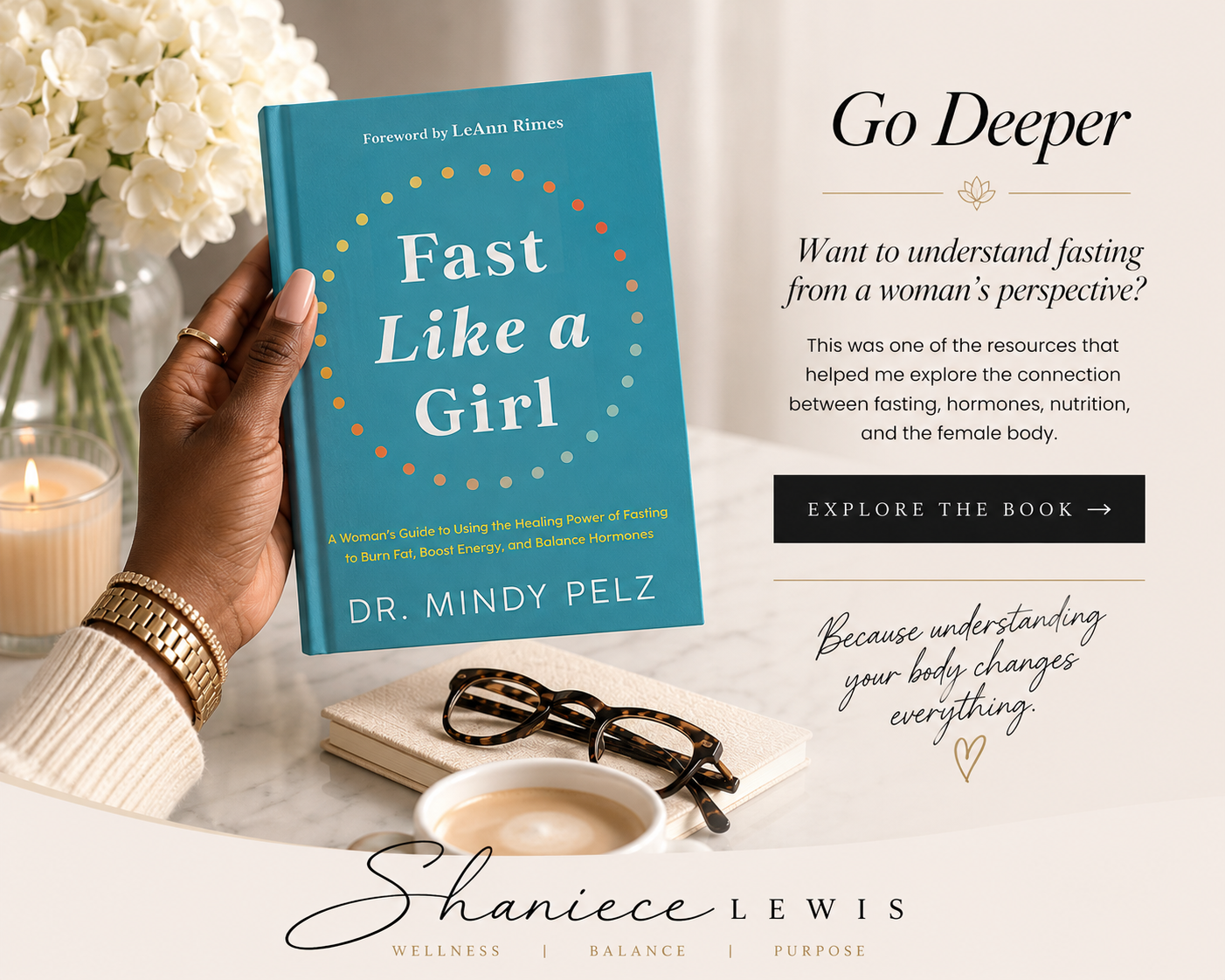
This book opened my eyes to a deeper conversation around fasting, hormones, nutrition, and the female body.
Instead of only asking:
“How long can I fast?”
I started asking:
“How can I approach fasting in a way that supports me as a woman?”
And that question changed everything.
Fasting Isn’t About Willpower
Remember when I said I didn’t think I had the willpower?
Here’s what I learned:
Discipline is something you practice.
I didn’t jump into longer fasting overnight.
I started with intermittent fasting.
I learned.
I practiced.
I became consistent.
Then I challenged myself.
And eventually, something I once thought I couldn’t do became something I understood how to do.
That’s why I don’t want you to read this and immediately think:
“I’m going to do a 48-hour fast!”
No.
Start with curiosity.
Learn what fasting is.
Learn how your body responds.
Learn how to properly nourish yourself.
And learn what approach makes sense for you.
Your Body Is Worth Getting to Know
We spend so much time looking outside ourselves for answers that sometimes we forget how much our bodies are already doing.
Your body is constantly communicating with you.
Your hunger.
Your energy.
Your digestion.
Your sleep.
Your cravings.
Your cycle.
Fasting taught me to slow down enough to listen.
And that may be one of the most valuable things you can gain from exploring fasting:
a deeper relationship with your own body.
Fasting isn’t a magic cure, and it’s not appropriate for everyone. It’s a wellness practice that should be approached thoughtfully and with an understanding of your individual needs.
But if you’ve been curious about fasting, I encourage you to learn before you leap.
Want to Go Deeper?
If you’re a woman who’s ever wondered:
Should I fast differently?
What do hormones have to do with fasting?
Does my menstrual cycle matter?
How do I know what approach is right for me?
These are exactly the questions that made me want to learn more.
Fast Like a Girl by Dr. Mindy Pelz became one of the resources that helped me explore those questions from a woman’s perspective.
And that’s why I’m sharing it with you.
Don’t just follow a fasting trend. Understand it.
Read.
Learn.
Ask questions.
Listen to your body.
Because the goal isn’t to see how long you can go without food.
The goal is to understand your body well enough to know how to care for it.
And sometimes, wellness isn’t about adding more.
Sometimes, it’s about creating enough space to listen.
With love & intention,
Shaniece
Related Posts
Why You Keep Breaking Promises to Yourself (And How to Finally Stop)
We’ve all been there. You tell yourself, “This is the time…
10 August 2026
Leave A Comment