
How to Let Go of What You Can’t Control (And Finally Find Peace)
There’s something I’ve been learning about life that I wish I understood sooner:
I was never really in control.
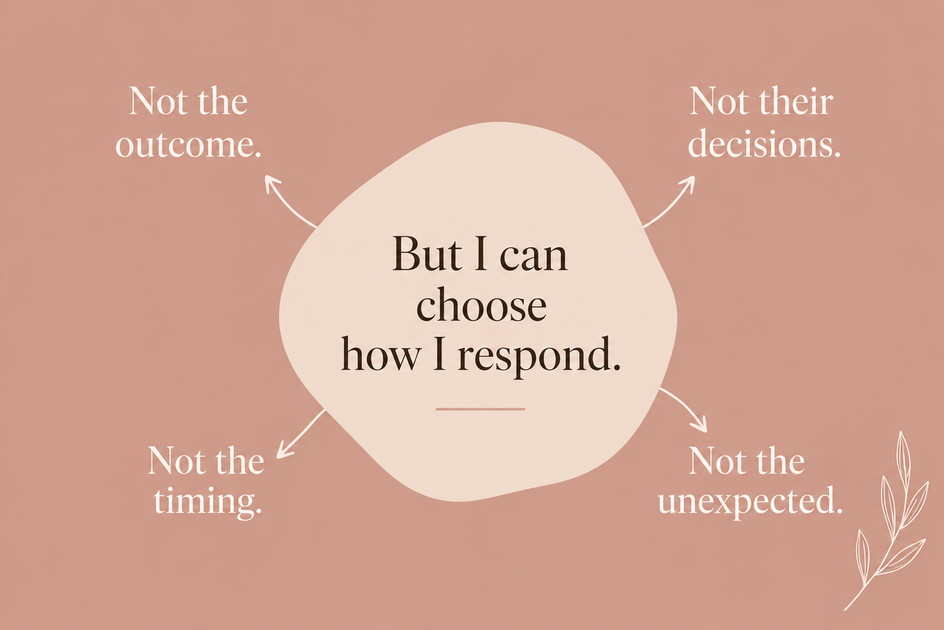
Not of how people treat me.
Not of whether things go according to plan.
Not of how quickly something happens.
Not of other people’s decisions.
Not of the unexpected phone calls, disappointments, delays, losses, changes, or circumstances I never saw coming.
And honestly?
That realization can be uncomfortable.
Because if we’re being real, a lot of us spend a surprising amount of our lives trying to control things we were never actually given control over.
We try to control the outcome.
We try to control how people perceive us.
We try to control what happens next.
We replay conversations, rethink decisions, create backup plans, and ask ourselves:
What could I have done differently?
What if I had said something else?
What if I had handled it better?
Sometimes, we’re not even looking for an answer.
We’re looking for a way to feel safe in something that feels uncertain.
“It makes no sense to worry about things you have no control over because there’s nothing you can do about them—and why worry about the things you do control? Worry keeps you stuck.”
Maybe you’ve heard a quote like this before.
Or maybe someone has said something similar to you.
But here’s the real question:
How often do we actually stop and listen to it?
Because it’s one thing to hear, “Don’t worry about what you can’t control.”
It’s another thing to actually live that way.
And that’s where the real work begins.
What if the goal isn’t to control life?
What if the goal is to learn how to respond to life?
That question changed the way I think about control, peace, and what it actually means to move forward.
When Trying to Control Everything Starts Costing You Your Peace
Think about the last time something didn’t go the way you expected.
Maybe you didn’t get the opportunity you wanted.
Maybe someone disappointed you.
Maybe a relationship changed.
Maybe your plans completely fell apart.
Maybe you did everything you thought you were supposed to do—and still ended up somewhere you never expected to be.
Your first thought probably wasn’t:
How can I respond to this thoughtfully?
It was probably something more like:
Why is this happening?
How did this happen?
This wasn’t supposed to happen.
What am I going to do now?
How do I fix this?
And there’s nothing wrong with having an emotional reaction.
We’re human.
You’re allowed to be disappointed. You’re allowed to be frustrated. You’re allowed to be hurt.
The problem is when your first reaction becomes your permanent response.
That’s where we can get stuck.
We keep replaying what happened.
We keep trying to understand why someone did what they did.
We keep imagining different outcomes.
We keep trying to solve something that may not actually be ours to solve.
And before we know it, we’re spending so much energy trying to control the situation that we’ve lost our peace in the process.
We can’t always choose what happens to us.
But we can become more intentional about what happens within us afterward.
And that distinction can change everything.
Control Isn’t the Same as Responsibility
This is something I’ve had to challenge in my own thinking.
Taking responsibility for your life doesn’t mean taking responsibility for everything that happens to you.
Those are two very different things.
You can be responsible for your choices without being responsible for someone else’s behavior.
You can be responsible for your healing without being responsible for what hurt you.
You can be responsible for your response without being responsible for the situation itself.
That’s a powerful shift.
Because when you stop asking:
“How do I control this?”
you can start asking:
“What is mine to do from here?”
That question brings your power back.
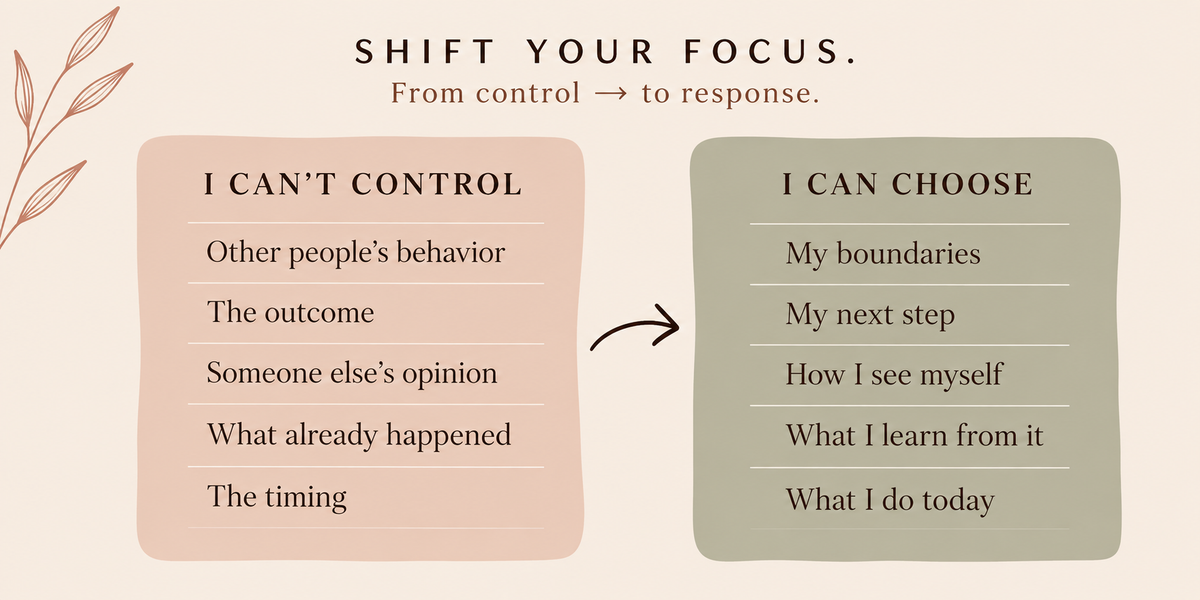
Maybe you can’t control what someone says about you.
But you can decide how you speak about yourself.
Maybe you can’t control someone else’s decision.
But you can decide what you do next.
Maybe you can’t change what happened.
But you can decide what you learn from it.
Maybe you can’t control the outcome.
But you can still take the next step.
That’s the difference between trying to control life and learning how to respond to it.
Give Yourself a Pause Before You Respond
One of the simplest mindset shifts I’ve been practicing is creating space between what happens and what I do next.
Something happens.
PAUSE.
BREATHE.
PROCESS.
THEN RESPOND.
Simple, right?
But that little pause can be powerful.
Because when we’re emotional, we don’t always need another answer.
Sometimes we need a moment.
A moment to breathe before sending the text.
A moment to process before having the conversation.
A moment to think before making a decision.
A moment to ask ourselves whether we’re responding to what’s actually happening—or reacting to everything we’re afraid might happen.
So before you respond, ask yourself:
Is this actually within my control?
If it isn’t, you don’t have to carry the responsibility of fixing it.
Then ask:
What part of this is mine?
Maybe it’s your attitude.
Maybe it’s your boundaries.
Maybe it’s the conversation you need to have.
Maybe it’s walking away.
Maybe it’s asking for help.
Maybe it’s changing your expectations.
Or maybe it’s simply giving yourself permission to feel what you feel without allowing that feeling to make every decision for you.
You don’t have to pretend something doesn’t hurt.
You just don’t have to let the hurt drive the car.
Changing Your Mindset Takes Practice
We sometimes talk about changing our mindset as if one inspirational quote is going to completely transform the way we think.
I wish it worked that way.
But it usually doesn’t.
Learning how to let go of what you can’t control is a practice.
You have to catch the thought.
Challenge the thought.
Replace the thought.
And then practice the new thought again.
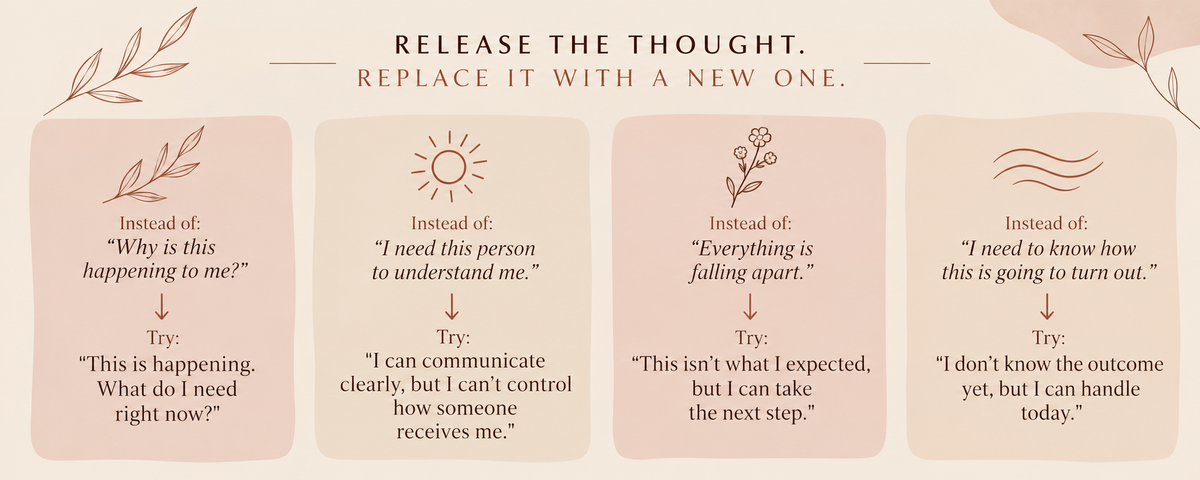
Instead of:
“Why is this happening to me?”
Try:
“This is happening. What do I need right now?”
Instead of:
“I need this person to understand me.”
Try:
“I can communicate clearly, but I can’t control how someone receives me.”
Instead of:
“Everything is falling apart.”
Try:
“This isn’t what I expected, but I can take the next step.”
Instead of:
“I need to know how this is going to turn out.”
Try:
“I don’t know the outcome yet, but I can handle today.”
That last one is important.
Because sometimes we’re not overwhelmed by what’s happening today.
We’re overwhelmed by everything we’re imagining could happen tomorrow.
We’re living ten steps ahead of ourselves.
We’re worrying about conversations that haven’t happened.
We’re preparing for problems that may never come.
We’re trying to figure out an ending before we’ve even made it through the middle.
And here’s the thing:
Tomorrow isn’t asking you to live it yet.
Today is enough.
You Don’t Have to Have All the Answers
There is a certain kind of freedom that comes with being able to say:
“I don’t know.”
I don’t know how this will work out.
I don’t know why this happened.
I don’t know what the next chapter looks like.
I don’t know what someone else is going to decide.
And that’s okay.
For me, faith has played a big part in learning this.
I’ve had to learn that I don’t have to understand everything to keep moving forward.
I can trust God with the things I can’t see while still taking responsibility for the things I can.
That’s where faith and mindset meet for me.
Not in pretending everything will always go the way I want.
Not in believing that difficult things won’t happen.
But in believing that I can keep moving even when they don’t.
Sometimes faith isn’t about having all the answers.
Sometimes it’s about being willing to take the next step without them.
So, What Do You Do When Life Doesn’t Go According to Plan?
The next time something happens that you didn’t expect, don’t immediately try to fix everything.
Start smaller.
Take a breath.
Then ask yourself:
01 — What happened?
02 — What am I feeling?
03 — What is actually within my control?
04 — What isn’t?
05 — What do I need right now?
06 — What response would make me proud of myself later?
And then take the next right step.
Not the perfect step.
Not the step that guarantees the outcome.
Not the step that makes everyone else happy.
Just the next right one.
Because life will continue to surprise us.
Some surprises will be beautiful.
Some will hurt.
Some will completely reroute us.
That’s life.
We can make plans. We can prepare. We can be intentional. We can make wise choices.
But there will always be things we simply cannot control.
And maybe peace isn’t found in finally getting life to behave the way we want it to.
Maybe peace comes from realizing:
I don’t have to control everything to be okay.
I can control how I speak.
How I care for myself.
How I show up.
What I believe.
What I allow.
What I do next.
And sometimes, that’s more than enough.
Maybe the goal was never to control the world around us.
Maybe the real work is learning how to become grounded enough that when the world changes around us, we don’t lose ourselves with it.
Because letting go doesn’t mean you stop caring.
It doesn’t mean you stop trying.
It doesn’t mean you become passive or stop taking responsibility for your life.
Sometimes, letting go simply means recognizing what belongs to you—and having the courage to release what doesn’t.
And that?
That’s a kind of freedom worth practicing.
With love & intention,
Shaniece

Leave A Comment